
Search Window Sticker
Table of Contents
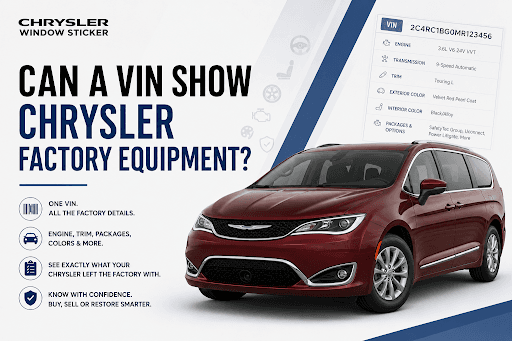
Shopping for a used Chrysler often leaves you wondering what features actually came from the factory. Whether you're verifying leather seats, an upgraded audio system, or a tow package, that 17-digit VIN on the dash holds all the answers, and you don't need to hunt down the original paper sticker in the glove box to find out.
Thanks to modern VIN decoders and online window sticker lookup tools, typing in a Chrysler’s VIN instantly pulls up its complete factory equipment list, original paint colors, option packages, and build specs.
Let's dig a little more into how this works and how you can use a VIN to unlock everything Chrysler built into your car.
Quick Answer
Yes, a VIN can show you the original factory equipment on a Chrysler.
When you put a VIN into a window sticker lookup tool or an advanced VIN decoder, the system processes those digits and pulls records tied to that exact vehicle. That gives you a full breakdown of:
 Factory-installed options and packages
- Original exterior paint color and interior trim
- Engine and transmission setup
- Original MSRP and pricing details
- Safety gear, wheels, and interior tech
So if you’re looking to verify options, spot fake trim badges, or just see how the vehicle was specced from day one, running the VIN through a window sticker generator is the easiest way to do it.
How a Chrysler VIN Identifies Factory Equipment?
Here's where people tend to get a little confused about how the process actually operates.
The 17-digit VIN itself acts like a unique fingerprint for your vehicle. Certain digits in the sequence tell you the basics, for example, model year, where the car got assembled, body style, and engine family. Yet when it comes to the smaller things, like heated seats, or a tow package, that’s where the lookup tool really does the heavy lifting.
When you type the VIN into a window sticker lookup service, the system decodes the number and then checks internal factory databases to pull the actual build record that Chrysler generated for that specific vehicle.
So instead of guessing off general trim listings, it produces a near reproduction of the original window sticker or the build sheet details. That means you’re not stuck with a generic menu of features that “could” be installed; you see the exact specs that were assigned to your car at the plant.
Key takeaway: Basically the VIN isn’t just some random run of digits. It’s the key that lets window sticker tools retrieve the precise build records Chrysler created at the factory, even for the little options most people overlook.
READ ALSO: Chrysler Build Sheet vs Window Sticker
What Factory Equipment Can You See on a Chrysler Window Sticker?
This is the stuff most people actually care about when shopping or selling.
Once you get hold of the original window sticker using the VIN, you get to see way more than the basic details from a standard VIN decoder. The sticker gives you a clear snapshot of how the car was originally built before it ever hit the dealer's lot, making it super easy to check if the equipment on the car today is actually supposed to be there.
Let's walk through some of the most helpful info you'll run across.
Engine and Powertrain Details
The engine is usually one of the first things people want to check on, especially if they're looking at a used Chrysler model that came with a few different engine choices.
For instance, two Chrysler 300s might look almost identical parked side by side, but one could have the standard V6 while the other left the factory with a 5.7L HEMI V8. Running the VIN through a sticker lookup confirms:
- Exact engine size and fuel type
- Horsepower and torque ratings
- Transmission type (like an 8-speed automatic)
- Drivetrain configuration (FWD, RWD, or AWD)
Trim Level
People tend to use trim names almost like they're totally interchangeable, but they're really not.
A Chrysler Pacifica Touring, Touring L, Limited, and Pinnacle might all share the exact same body shape, but the standard equipment on each one can be night and day.
The original window sticker confirms the real trim level and shows what Chrysler installed as standard features for that build. That's pretty handy, since trim badges sometimes get swapped around after body repairs, or sellers just accidentally list the wrong trim.
Original Paint and Interior Color Combinations
Paint can tell you a lot about a car's history. Maybe a previous owner repainted it, or maybe it was in a fender bender and got sprayed a slightly different shade.
A window sticker lists the official Chrysler paint color name (like Granite Crystal Metallic or Bright White) alongside the original interior color scheme (like Black/Alloy leather). If a seller claims the bright red paint is original but the VIN lookup shows it left the factory in dark blue, that’s a pretty big clue that something changed along the way.
Factory Option Packages
Factory packages are honestly one of the main reasons people run a VIN through a sticker tool in the first place.
Chrysler loves bundling features into packages, like the SafetyTec Group, Cold Weather Group, S Appearance Package, or Premium Sound Group. Just looking at a car sitting in a driveway doesn't always show the whole picture, because a lot of these upgrades aren't obvious until you look closely.
The window sticker breaks down every package installed at the factory, making it easy to see what's real and what isn't.
Interior Features and Tech
Interior features change a lot over a car's life. Seats get worn down, stereos get swapped, or steering wheels get replaced.
By decoding the VIN with a window sticker tool, you can verify features like:
- Leather vs. cloth seating
- Heated and ventilated front seats, plus heated rear seats
- Heated steering wheel and power-adjustable pedals
- Exact Uconnect touchscreen size (e.g., 8.4-inch or 10.1-inch)
- Premium audio systems like Alpine or Harman Kardon
- Apple CarPlay and Android Auto integration
Exterior Equipment
Exterior details can change a whole lot over a car's life. Wheels get swapped out, spoilers get slapped on, mirrors get swapped, or paint gets redone after a scrape.
Because of all that, it's nice having an official reference showing what actually came on the car.
Depending on the model, the factory window sticker usually lists:
- Exterior paint color name
- Alloy wheel design and size
- Factory tire specs
Standard power sunroof vs. dual-pane panoramic sunroof
- Roof rails and accents
- LED lighting or fog lamp setups
- Exterior appearance packages
That makes it way easier to compare the car standing in front of you against how Chrysler actually built it.
Technology Features
Car tech has shifted like crazy over the last decade.
Some Chrysler models came with really basic infotainment setups, while others were equipped with massive touchscreens, premium speakers, built-in nav, and extra tech connections. Just looking at the dash today doesn't tell you everything, since electronics can be modified or swapped after purchase.
The original window sticker clears up what Chrysler actually installed.
Common tech items include:
- Uconnect system version and screen size
- Built-in navigation
- Apple CarPlay and Android Auto setup
Upgraded audio system (like Alpine or Harman Kardon)
- Wireless charging pads
- Bluetooth and USB port layouts
Knowing what came on the car originally also makes it easier to figure out what it's actually worth compared to similar listings.
Safety Systems and Driver Assist Gear
Safety tech is another big deal for buyers, especially on newer Chrysler models like the Pacifica.
Two minivans might look identical on the outside, but one might have thousands of dollars in added safety features. A VIN lookup can confirm if the car came equipped with:
- Adaptive Cruise Control with Stop and Go
- Blind Spot and Rear Cross-Path Detection
- LaneSense Lane Departure Warning
- Full-Speed Forward Collision Warning
- 360-degree Surround View Camera systems
Wheels and Tires
Wheels are one of those things people swap out all the time. Some owners upgrade to bigger aftermarket rims, others switch back to smaller wheels for winter, and some simply replace a damaged wheel with whatever they can find cheap. By the time a car hits ten years old, there’s a good chance it’s not riding on the exact setup it left the factory with.
That's where the window sticker comes in handy.
Instead of guessing what's supposed to be on there, you can look at the factory equipment list to see the original wheel size, tire specs, and style Chrysler installed.
You'll usually see:
- Wheel diameter and finish
- All-season or performance tire types
- Spare tire setup
It might not seem like a massive deal at first, but original wheel packages affect both drive quality and resale value.
Original MSRP and Price Breakdown
One section people forget to look at is the pricing breakdown.
Most buyers focus purely on the engine or trim, but the original MSRP tells you a ton about how the car was outfitted.
Imagine you're looking at two Chrysler Pacificas from the same year. They have similar miles, look clean, and both sellers are asking around $22,000. At first, they look like the exact same deal.
Then you check the window stickers.
One originally stickered for several thousand dollars more because it was packed with leather, a panoramic roof, safety tech, and upgraded audio. The other was a bare-bones build.
Suddenly, those two listings aren't so identical after all.
The sticker breaks down:
- Base MSRP
- Individual option costs
- Package pricing
- Destination charges
- Total original MSRP
That makes comparing used listings way more apples-to-apples instead of just assuming every car with the same trim name is built the same way.
Fuel Economy Ratings
Fuel economy might not be the main reason you check factory equipment, but it's always right there on the original window sticker.
It shows the EPA estimates from when the car was brand new - city, highway, and combined. This is mostly helpful when you're comparing different Chrysler engine setups. A V6 and a V8 are going to feel totally different to drive, and their original fuel ratings make that cost difference pretty clear.
What Information Isn't Stored in the VIN?
This is probably the biggest misunderstanding people run into.
Because a VIN can unlock so much information, it's easy to assume all those details are literally sitting inside those 17 characters.
They're not.
The VIN just identifies the car. From there, lookup tools match that VIN up with external databases that hold the actual records.
For instance, the VIN itself doesn't store:
- Dealer-installed add-ons
- Previous owner history
- Accident or damage records
- Maintenance and service history
- Open safety recalls
- Title issues
All that info comes from completely different places. A vehicle history report pulls from DMVs and insurance companies, while a window sticker comes straight from factory records. They're all connected by the VIN, but they're entirely separate pieces of documentation.
VIN Decoder vs Window Sticker vs Build Sheet
People often use these terms as if they mean the same thing. They don't.
They all start with the VIN, but each one serves a different purpose.
Feature | VIN Decoder | Window Sticker | Build Sheet |
Basic vehicle identification | ✅ | ✅ | ✅ |
Engine information | ✅ | ✅ | ✅ |
Transmission | ✅ | ✅ | ✅ |
Factory packages | Limited | ✅ | ✅ |
Interior features | Limited | ✅ | ✅ |
Exterior features | Limited | ✅ | ✅ |
Paint and interior colors | Sometimes | ✅ | ✅ |
MSRP | ❌ | ✅ | ✅ |
Fuel economy ratings | ❌ | ✅ | ❌ |
Factory sales codes | ❌ | Sometimes | ✅ |
Production details | ❌ | ❌ | ✅ |
A basic VIN decoder is usually the quickest way to identify the vehicle itself.
A window sticker focuses on how Chrysler equipped and sold the vehicle.
A build sheet goes even deeper by showing production information and factory sales codes that were used during assembly.
That's why enthusiasts, collectors, and restorers often use all three together instead of relying on just one.
Can Two Chrysler Vehicles Have the Same VIN Information but Different Factory Equipment?
Absolutely.
This surprises a lot of people because two Chrysler vehicles can have the same year, model, engine, and trim, yet still leave the factory with different equipment.
For example, two 2022 Chrysler 300 Touring models might share the same:
- Engine
- Transmission
- Exterior color
- Similar mileage
But one could also include:
- Premium Alpine audio
- Dual-pane panoramic sunroof
- Heated steering wheel
- Heated rear seats
- Driver assistance package
- Navigation system
...while the other has none of those options.
That's exactly why the original window sticker is so useful. It shows the factory equipment tied to that specific VIN, not just the features that were available for that model.
How to Get a Chrysler Window Sticker Using Your VIN?
If you want to pull up the original factory equipment list yourself, the process is pretty straightforward and only takes a minute or two.
Step 1: Find Your Chrysler’s VIN
First, you'll need the 17-digit VIN. You can spot it in a few common places:
- On the driver’s side dashboard, visible through the bottom corner of the windshield
- On the sticker inside the driver’s door jamb
- Listed on the vehicle title, registration card, or insurance paper
Make sure you write it down carefully. Entering even one wrong letter or number will bring up an error or a totally different vehicle.
Step 2: Use a Reliable Window Sticker Lookup Tool
Head over to our window sticker lookup tool that handles Chrysler records. Type in your 17-digit VIN and run the search.
Step 3: Review and Save Your Window Sticker
Once the system processes the VIN, it will display the generated window sticker showing all the standard features, optional equipment, colors, and pricing. You can usually save it as a PDF or print it out to keep with your car's service records.
Step 4: Compare the Sticker to the Vehicle
If you're buying a used Chrysler, take the generated sticker with you when you inspect the car. Check to make sure the factory wheels are still on it, the audio system matches what's listed, and no key options have been removed or swapped out by previous owners.
Why Checking Factory Equipment by VIN Matters?
If you're shopping around, putting your own car up for sale, or restoring a classic, pulling the factory details by VIN saves a lot of headaches.
For Buyers
It keeps you from getting tricked by misleading sales ads. Sellers don't always know every option their car has, or worse, they might claim a car is "fully loaded" when it's actually missing major packages. Having the window sticker lets you verify every claim before handing over any money.
For Sellers
If you're trying to sell your Chrysler, showing potential buyers the official window sticker builds instant confidence. Instead of just listing basic details, you can prove that your car came with $5,000 in factory options, justifying a higher asking price.
For Owners and Restorers
If you bought a used car and want to know everything it came with, or if you're restoring an older Chrysler model to its original factory condition, the build records tell you exactly what paint shades, trim pieces, and equipment were installed when it first left the line.
Can the Vehicle Differ From What the VIN Shows?
Yeah, it actually can, and finding minor differences is more common than you might think.
A VIN lookup tells you how Chrysler built the vehicle at the factory. However, cars change over time as different owners drive them. Some common reasons the car might not match the sticker today include:
- A previous owner added aftermarket wheels or upgraded the stereo
- The car was repainted a different color after a scrape or accident
- Seats were reupholstered or swapped out
- Dealer-installed accessories were added after the car left the factory (which wouldn't show on the factory window sticker)
That’s why using a VIN lookup tool alongside a physical inspection is always the best way to get the full story on any used Chrysler.
Can You Trust Factory Equipment Retrieved by VIN?
Generally speaking, yes. If the information comes directly from factory records associated with that VIN, it's usually a very reliable representation of how the vehicle was built and sold.
The thing is, not every lookup service uses the same data sources. Some tools only decode the VIN itself, while others retrieve official manufacturer records tied to that exact vehicle. That's why you may notice one website showing only a handful of details, while another provides the complete factory equipment list, pricing, colors , and packages.