
Search Window Sticker
Table of Contents
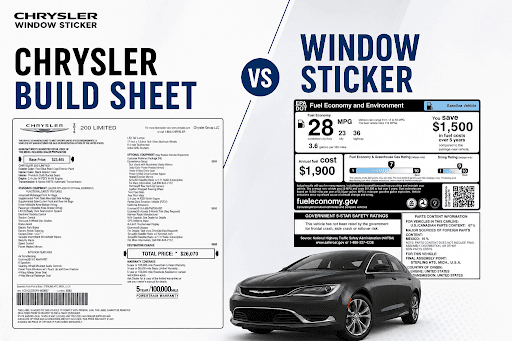
Summary: When people shop for a Chrysler, restore one, or verify a classic car’s factory details, two documents come up again and again: the build sheet and the window sticker. They may sound similar at first, but they serve very different jobs.
The short version is this: the build sheet is the factory’s internal production record, while the window sticker is the consumer-facing summary that was displayed on the car when it was new. One is mostly for the plant, the other is mostly for the buyer.
That simple difference changes everything.
A build sheet can tell you how Chrysler intended the car to be assembled at the factory. It is the closest thing to a production blueprint. A Chrysler window sticker, on the other hand, shows how Chrysler wanted the car presented to a retail customer. It usually includes the final MSRP, standard equipment, options, engine details, fuel economy data, and other sales information.
For collectors, dealers, buyers, and restorers, knowing the difference matters because each document answers a different question. The build sheet helps answer, “Was this car built this way from the start?” The window sticker helps answer, “How was this car equipped and priced when it was sold new?”
What a Chrysler Build Sheet Is
A Chrysler build sheet is a factory document used during assembly. It tells the plant exactly how to build a specific vehicle. Think of it as a production instruction form. It includes the VIN, body code, paint code, trim code, engine code, axle code, option codes, and assembly details that guide workers through the build process.
In plain terms, the build sheet is Chrysler’s behind-the-scenes record of how a vehicle should leave the line.
For older Chrysler vehicles, especially classic Mopars, the build sheet is often more valuable than people first realize. It can confirm original drivetrain setup, trim choices, paint, and factory-installed equipment. That matters because originality can have a big effect on value. A car that still matches its factory build can be more desirable than one that has been heavily altered.
Build sheets are also useful when a car has missing or changed parts. If the engine was swapped, the interior was reupholstered, or the paint changed years ago, the build sheet can help reveal what the car was supposed to have from day one.
READ ALSO: How to Get a Chrysler Build Sheet by VIN
What a Chrysler Window Sticker Is
A Chrysler window sticker, often called a Monroney label in the United States, is the label placed on a new vehicle for sale. It was designed for buyers, not factory workers. It gives a clear view of the car’s trim, standard equipment, optional equipment, pricing, fuel economy, and other consumer information.
If the build sheet is the factory’s instruction manual, the window sticker is the showroom sheet.
A Chrysler window sticker usually includes things like:
 Model year
- Model and trim
- VIN
- Engine
- Transmission
- Standard equipment
- Optional equipment
- Package pricing
- Destination charge
- Total MSRP
- Fuel economy information
- Safety or emissions details
- Exterior and interior colors
- Wheels and tires
This makes the window sticker a powerful document for buyers who want to see how the car was originally sold. It is also useful for used-car shoppers who want to confirm the exact trim and features before making a purchase.
The Main Difference in Purpose
The biggest difference between the two documents is purpose.
The build sheet is made for production. It exists so the factory knows how to assemble the car correctly. It is not meant to sell the car to a customer.
The window sticker is made for sales. It exists so the dealer can show the car’s equipment and price in a clear, regulated format. It is not meant to guide assembly workers.
This difference affects the level of detail too.
A build sheet may contain many internal codes that are easy for factory staff or serious Mopar enthusiasts to read, but confusing to the average person. A window sticker is usually easier to understand because it was designed for public viewing.
So, if you want to know how Chrysler built the car, the build sheet is the better document. If you want to know how Chrysler marketed and priced the car when it was new, the window sticker is the better document.
Which One Is More Detailed?
This depends on what kind of detail you mean.
If you mean factory codes and production intent, the build sheet is often more detailed. It may show hidden or internal information that never appeared on the window sticker. That includes specific option codes, build sequence details, and assembly instructions.
If you mean consumer-friendly equipment and price information, the window sticker is more detailed in a different way. It explains what the buyer saw on the lot. It often breaks equipment into readable categories like standard features, optional packages, and added charges.
So the right answer is not that one is always more detailed than the other. It is that each one is detailed in a different direction.
The build sheet dives into how the car was made. The window sticker explains how the car was sold.
Why Chrysler Build Sheets Matter
For Chrysler owners and Mopar collectors, build sheets can be extremely important. They help establish originality, which is a big deal in classic car circles.
A build sheet can help you confirm:
- Original engine configuration
- Transmission type
- Factory axle ratio
- Paint and trim combination
- Interior color and materials
- Optional equipment
- Factory-installed packages
- Special-order or unique build details
This matters because not all cars survive in original condition. Over decades, parts get replaced, modifications get made, and paperwork gets lost. A build sheet can act like a truth teller from the factory floor.
It is especially useful for classic Chrysler, Dodge, Plymouth, and other Mopar models where originality can affect restoration choices and market value.
For example, if a buyer sees a car with a big-block engine today, the build sheet may show that the car originally left the factory with a smaller engine. That single detail can change how the car is valued and restored.
Why Chrysler Window Stickers Matter
Window stickers matter because they show how the car was originally presented to the public. For modern and classic vehicles alike, that original retail snapshot can be very useful.
A window sticker can help you verify:
- The exact trim level
- Factory options and packages
- Original MSRP
- Destination charge
- Fuel economy ratings
- Equipment that came standard
- Exterior and interior color combination
- Wheel and tire setup
For buyers, this is helpful because it gives a clear picture of what the car started as. It can also prevent confusion when a listing mixes up trim names or claims equipment that may not have been standard.
For sellers, it can support a stronger asking price by showing the car’s original equipment and options.
For collectors, it can serve as proof of a desirable factory configuration.
How They Relate to Each Other
These two documents are connected, but they are not the same thing.
A build sheet may influence what ends up on a window sticker, because the car’s factory-installed equipment affects how it is represented at the dealer level. Still, the documents are created for different audiences and different stages of the vehicle’s life.
Here is a simple way to think about it:
- Build sheet: created for the factory during assembly
- Window sticker: created for the dealer and customer at sale time
A build sheet might contain codes that never appear on the sticker. A window sticker might show pricing and fuel data that never appear on the build sheet.
That is why many Chrysler researchers use both documents together. One can fill in gaps left by the other.
The Best Way to Read Them
Reading either document gets much easier once you know what to look for.
With a build sheet, start with the core factory data first:
- VIN
- Body code
- Paint code
- Trim code
- Engine code
- Transmission code
- Axle code
Then move to the option codes and production notes. These often tell you what was added at the factory beyond the base car.
With a window sticker, start with the consumer-facing details:
- Model year
- Trim name
- Standard equipment
- Optional packages
- Total price
- Destination charge
- Fuel economy
- Color and finish details
Once you understand those sections, the rest becomes much easier to interpret.
A Simple Example
Imagine a Chrysler sedan from the factory.
The build sheet might show that the car was built with a specific engine code, a certain axle ratio, a particular trim package, and a given paint color. It may also list factory options such as upgraded seats, a premium sound system, or a performance package.
The window sticker might show the same car as a retail product, with the trim name, package names, MSRP, destination fee, and fuel economy ratings clearly displayed for the buyer.
Both documents describe the same car, but from different angles.
That is the key point.
One tells the factory story. The other tells the sales story.
READ ALSO: Chrysler Trim Levels Explained: What Every Trim Means
Why This Difference Matters for Buyers and Collectors
If you are buying a Chrysler, the difference between these documents can save you from confusion and help you judge the car more accurately.
A window sticker may tell you the car was sold with certain features. A build sheet can tell you whether those features were truly factory-installed or added later. That is a big deal when you are paying for originality.
For collectors, this difference can also affect restoration strategy. If the goal is a factory-correct restoration, the build sheet becomes a roadmap. If the goal is to understand the car’s original retail package and price, the window sticker becomes the reference point.
For sellers, having both documents can strengthen trust. It gives buyers more confidence that the car is what it claims to be.
For restorers, both documents can help avoid expensive mistakes.
Chrysler Build Sheet vs Window Sticker - Side by Side Comparison
A Chrysler build sheet and a Chrysler window sticker may both describe the same vehicle, but they do so in very different ways. The easiest way to understand them is to compare them side by side.
Build Sheet
The build sheet is a factory document used during production. It tells Chrysler workers how the vehicle should be assembled. It is packed with internal codes, order data, paint codes, trim codes, option codes, drivetrain details, and assembly information.
Window Sticker
The window sticker is a sales document used at the dealership. It tells buyers what the car included, how it was priced, and how Chrysler presented it to the public. It is written in clearer language and focuses on equipment, pricing, fuel economy, and trim information.
Which One Should You Use?
The right document depends on what you are trying to prove or learn.
Use the Build Sheet When You Want to:
- Verify original factory assembly details
- Confirm engine, transmission, axle, and trim codes
- Check if a vehicle still matches its birth configuration
- Research a classic Chrysler for restoration
- Decode factory option codes
- Spot changes made after the vehicle left the plant
Use the Window Sticker When You Want to:
- See original MSRP and destination charge
- Confirm the exact trim level
- Review standard and optional equipment
- Understand the car’s original retail presentation
- Compare listed features with what Chrysler actually sold
- Help buyers understand the value of factory options
Use Both When You Want a Full Picture
The strongest research comes from using both documents together.
A build sheet gives the factory truth. A window sticker gives the sales truth. When both line up, you get a much clearer view of the car’s original identity.
Which One Is Better for Classic Chrysler Cars?
For classic Chrysler cars, the build sheet is often the more important document because originality matters so much in the collector market.
A classic Chrysler may have had:
- An engine swap
- A repaint
- A replaced interior
- A non-original transmission
- Aftermarket wheels
- Modified suspension parts
A build sheet helps cut through all of that by showing what the car was supposed to have when it left the plant.
That said, the window sticker is still valuable. It can show the original equipment package, pricing, and retail presentation. For buyers and sellers, that can help explain why one car is more desirable than another.
Which One Is Better for Modern Chrysler Vehicles?
For newer Chrysler models, the window sticker is usually the more useful first document because it is easier to read.
Modern buyers often want to know:
- What trim they are looking at
- What features came standard
- Which options were added
- What the original sticker price was
- How the vehicle was rated for fuel economy
The window sticker answers those questions quickly.
The build sheet still matters, especially for deep verification, but most shoppers start with the sticker because it is simpler to understand at a glance.
Where You Can Find a Chrysler Build Sheet
Finding a Chrysler build sheet is not always easy. The location depends on the year, model, and how the vehicle was stored or restored over time.
Common places to find one include:
- Under seats
- Inside seat springs
- Beneath carpeting
- On top of the fuel tank
- Behind interior panels
- Under the dash
- Inside the glove box
- In original paperwork stored by past owners
Classic Mopar owners often discover them in hidden factory spots that were never meant to be obvious.
Sometimes the build sheet survives for decades. Other times it is gone completely because of repairs, rust, cleaning, or interior replacement.
Where You Can Find a Chrysler Window Sticker
Window stickers are easier to understand, but original ones are not always easy to locate.
You may find one through:
- Original dealer paperwork
- Past owner records
- Collector files
- Online Chrysler window sticker lookup tools
- Vehicle history and documentation services
For older cars, the original sticker is sometimes preserved by collectors because it adds value and authenticity.
For newer vehicles, it is often easier to recover a copy using the VIN.
READ ALSO: Chrysler Window Sticker Lookup: What Information Can You Find?
Common Misconceptions About Build Sheets and Window Stickers
People mix these two documents up all the time. Here are some of the most common mistakes.
Misconception 1: They Are the Same Thing
They are not the same.
A build sheet is a production record. A window sticker is a sales label. They serve different jobs and are created for different audiences.
Misconception 2: The Window Sticker Proves Factory Originality
Not fully.
A window sticker can show what Chrysler intended to sell, but it does not always prove the car still has those parts today. The build sheet is better for that.
Misconception 3: The Build Sheet Is Easier to Read
Usually not.
Build sheets often use codes and factory shorthand. Window stickers are normally easier for the average person to read.
Misconception 4: A Missing Build Sheet Means the Car Is Fake
Not necessarily.
Many real Chrysler cars no longer have their original build sheets. Age, repairs, and storage conditions can all destroy them.
Misconception 5: A High MSRP Means the Car Is Rare
Not always.
A high original sticker price may just mean the car had expensive options. Rarity depends on production numbers, equipment mix, and surviving examples, not price alone.
What Collectors Look For
Collectors often examine both documents very carefully because small details can change how a Chrysler is valued.
They may look at:
- Matching VINs
- Factory engine codes
- Transmission type
- Original paint code
- Interior trim code
- Axle ratio
- Special-order options
- Performance packages
- Dealer-installed equipment versus factory-installed equipment
These details help separate a truly original car from one that only looks original on the surface.
Why Restorers Care So Much
Restorers use build sheets and window stickers as reference points.
The build sheet tells them what to reinstall or source. The window sticker tells them how the car was originally presented.
That matters when restoring:
- Interior materials
- Correct exterior paint
- Factory wheels
- Trim pieces
- Engine bay components
- Badging
- Factory option packages
Without those documents, restorers may guess. With them, they can work with far more confidence.
Why Buyers Should Care
If you are buying a Chrysler, these documents help you make a smarter decision.
A seller may say the car is original, fully loaded, rare, or factory correct. The documents help confirm or challenge those claims.
They can also help you see:
- What the car was when new
- What the car has now
- What may have been changed
- Which options really matter
- Whether the asking price makes sense
That is especially important for classic models where documentation can strongly affect value.
Why Sellers Should Care
If you are selling a Chrysler, having one or both of these documents can build trust fast.
A window sticker helps show original equipment and MSRP. A build sheet helps show factory authenticity.
Together, they make your listing stronger because buyers can verify the car instead of taking your word for it.
That can help reduce doubt and make serious buyers more confident.
Quick Answer Summary
Here is the simplest way to remember the difference:
- Build sheet = factory production record
- Window sticker = original retail sales label
- Build sheet = internal codes and assembly data
- Window sticker = equipment, pricing, and consumer details
- Build sheet = best for originality checks
- Window sticker = best for original sales presentation
Final Thought on Chrysler Build Sheet vs Window Sticker
For Chrysler owners, collectors, and buyers, these two documents are not competitors. They are partners.
The build sheet shows how the car was made. The window sticker shows how the car was sold. Used together, they give you the clearest possible picture of a Chrysler’s original identity.
That is why serious Mopar research usually starts with both.