
Chrysler Sales Codes: What They Are and How to Read Them
Search Window Sticker
Table of Contents
Key Takeaways
- Chrysler sales codes are short alphanumeric identifiers that label every feature, option, and paint color installed at the factory.
- They work like GM's RPO codes, acting as a shorthand reference for factory equipment.
- Where you find them depends on the vehicle's age, ranging from metal fender tags on classics to door jamb stickers and digital VIN records on newer models.
- Sales codes are crucial for verifying authenticity, helping buyers confirm factory equipment and helping restorers order parts that actually fit.
- If physical tags are missing, a VIN lookup or window sticker tool can usually pull the same data digitally.
If you've ever looked at a Chrysler window sticker, fender tag, or door jamb sticker and seen a random string of letters and numbers that look completely made up, you've run into sales codes.
These short codes are basically the factory's shorthand for everything your vehicle was built with, from the exterior paint color and engine size to specific option packages.

Chrysler sales codes are different from your VIN. The VIN identifies one specific vehicle, but the sales codes describe what that car was actually outfitted with at the plant. Together, they tell the full picture of how your Chrysler rolled off the line.
What Are Chrysler Sales Codes?
Think of sales codes as the factory's internal shorthand.
They’re short 2 to 4-character codes Chrysler assigns to specific features, colors, and option packages. Every single item has its own code, whether it's a specific metallic paint, an 8-speed automatic transmission, or a heavy-duty towing package.
These codes trace back to Chrysler's internal ordering and inventory systems. The factory needed a fast, standardized way to tell assembly workers exactly what to bolt onto each chassis, and parts departments needed a way to match replacement parts to specific builds later on.
If you're familiar with General Motors cars, you might know these as RPO codes (Regular Production Option codes). Chrysler's sales codes do the exact same job, just under a different naming setup.
READ ALSO: Chrysler Trim Levels Explained: What Every Trim Means
Where to Find Sales Codes on Your Vehicle?
Where you find your sales codes really comes down to how old your Chrysler is.
 Fender tag or body tag: On classic Chrysler, Dodge, and Plymouth cars from the 1960s and 1970s, you’ll usually find a metal tag riveted under the hood on the firewall or inner fender. It’s stamped with a dense block of codes covering paint, trim, engine, and factory options.
- Door jamb sticker: Newer models usually carry a sticker inside the driver-side door jamb. It lists key codes alongside the VIN in a much cleaner, easier-to-read format.
- Broadcast sheet: Some cars left the factory with a paper broadcast sheet (build sheet) tucked inside. You can sometimes still find them under the seat springs, behind door panels, or under the trunk mat in original cars. Restorers love finding these intact.
- Window sticker (Monroney label): The original window sticker lists standard features, options, and packages in plain language, often placing the matching sales code right next to them.
How to Read a Sales Code?
Most Chrysler sales codes are pretty short, usually combining two to four letters and numbers. The structure shifts a bit depending on the era, but most codes fall into these main buckets:
- Exterior color codes: Name the specific paint color and finish type.
- Interior trim and color codes: Spell out the seat material, color scheme, and trim tier.
- Engine and transmission codes: Indicate engine size, cylinder count, and gearbox type.
- Axle ratio codes: Define the rear differential gearing, which dictates towing capacity and off-the-line pull.
- Option package codes: Represent bundled upgrades like a Luxury Group, Cold Weather Group, or sport package.
- Regional and emissions codes: Mark vehicles built to meet specific state requirements, like California emissions.
Sales Codes by Era
The way Chrysler handled these codes changed quite a bit over the decades:
Classic Muscle Car Era (1960s to 1970s)
This is where reading fender tags gets super important. Mopar restorers rely heavily on these codes to verify numbers-matching cars and original factory configurations, which can drastically change what a classic Mopar is worth.
1980s to 1990s
Chrysler shifted toward computerized build tracking during this stretch. Metal tags slowly gave way to door stickers and digital factory records, making the documentation a lot more standardized across different models.
Modern Era (2000s to Present)
Door jamb stickers and VIN-linked databases hold most of this info now. A quick VIN lookup today can usually pull the same exact build details that used to require crawling under a dashboard to find a paper tag.
Common Sales Codes and What They Mean
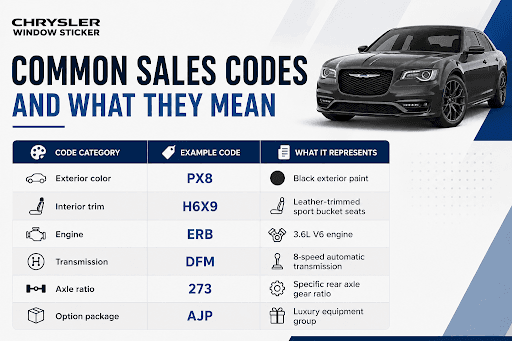
Exact codes vary depending on the model year and vehicle line, but here’s a quick peek at how some of these codes look in the real world:
Code Category | Example Code | What It Represents |
Exterior color | PX8 | Black exterior paint |
Interior trim | H6X9 | Leather-trimmed sport bucket seats |
Engine | ERB | 3.6L V6 engine |
Transmission | DFM | 8-speed automatic transmission |
Axle ratio | 273 | Specific rear axle gear ratio |
Option package | AJP | Luxury equipment group |
READ ALSO: Chrysler VIN Decoder Explained: What Information Can You Find?
Why Do Sales Codes Matter?
Before you get into the specific situations, it's worth understanding why these codes matter in the first place.
- For Restorers: Sales codes confirm if a car's engine, paint, and interior match how it left the plant. That's huge for keeping a classic build authentic and protecting its market value.
- For Buyers: Checking the sales codes lets you see if a used Chrysler actually has the factory features listed in the ad, so you don't have to just take the seller's word for it.
- For Sellers & Collectors: Documented, factory-correct sales codes help justify a higher price tag by proving originality to hesitant buyers.
- For Parts Shopping: Matching the exact sales code ensures you order replacement parts built for your specific setup, rather than a generic part that might not fit right.
Sales Codes vs. VIN vs. Window Sticker
People mix these three sources up a lot because they all deal with vehicle specs, but they do very different jobs:
Source | What It Tells You | Where to Find It |
VIN | Identifies the core vehicle, year, engine tier, and assembly plant. | Dashboard, door jamb, title, registration. |
Sales Codes | Breaks down the exact equipment, paint, and options installed. | Fender tag, door jamb sticker, build sheet. |
Window Sticker | Lists standard features, options, and original pricing in plain text. | Original sales paperwork, or a VIN lookup tool. |
If you're missing the original door tag or paperwork, running a window sticker lookup can rebuild much of this data digitally, giving you a full window sticker breakdown tied directly to your VIN.
How to Decode Your Sales Codes?
- The Manual Route: Find your physical fender tag, door sticker, or paper build sheet, then cross-reference those codes against Chrysler’s decoder guide for your specific year and model. This is still the go-to path for classic Mopars.
- Online VIN Lookup: For a faster route, a window sticker lookup tool can pull those same factory records automatically. It formats everything into plain English without you needing to hunt down an old metal tag under the hood.
Final Thoughts on Chrysler Sales Codes
At the end of the day, Chrysler sales codes are small details that make a huge difference. They verify original builds, keep you from ordering the wrong replacement parts, and give you proof of what a car actually came with.
Whether you're restoring an old classic or checking out a used Chrysler before handing over your money, understanding these codes puts real facts behind what you're looking at.
And if the original tags are long gone, running the VIN to pull a rebuilt window sticker is usually the fastest way to bring all those factory details back to light.